
*Last updated: April 2026
Child Custody & Move-Aways
After divorce, parents may wish to relocate, sometimes far away, but taking children along requires more than just a personal decision—it often requires court approval when parents disagree. Understanding how judges evaluate relocation requests is crucial for both the parent who wants to move and the parent who will remain. Learn what influences these decisions and how to prepare your case.
Child Custody & Move-Aways
After divorce, parents may wish to relocate, sometimes far away, but taking children along requires more than just a personal decision—it often requires court approval when parents disagree. Understanding how judges evaluate relocation requests is crucial for both the parent who wants to move and the parent who will remain. Learn what influences these decisions and how to prepare your case.

Facing a relocation dispute after divorce? Protect your rights and your children’s best interests.
After divorce, a parent may wish to move out of the area where they and their ex-spouse live for any of a variety of reasons. But while an adult has the legal right to move wherever they wish, they don’t necessarily have the right to take the children of that previous marriage with them. To the parent seeking to move, the benefits might seem obvious, but when parents don’t agree on a proposed relocation, it is up to a judge to decide if a child goes or stays. Whether you are hoping to move out of state or internationally with your children or you are the parent who might be left behind by an ex-spouse’s move, here’s some important information on relocation and child custody to illuminate why a judge may say no to a proposed move.
What You'll Learn
Understanding Best Interests of the Child
Courts in California are required to prioritize the best interests of the child in family law matters like custody, because while children are directly impacted by the court’s decisions, they most often do not have direct control over what is decided on their behalf. The Family Code also specifies that children should have “frequent and continuing contact with both parents” unless such contact is not in their best interests (for example, in cases of neglect or abuse).
This does not mean that it is impossible for one parent to relocate with the child either out of state or internationally—but they will need to make a strong case that the move would have enough benefit to the child to balance any negative impact of increased distance from their other parent, and/or that it will be possible to mitigate such negative effects through adjusted custody arrangements such as longer visitation over holidays or other strategies to maintain frequent contact. A great deal will depend on the terms of the existing custody order. However, when considering a request to modify a custody agreement to accommodate a long-distance move with the child, the court will look at a range of other factors as well.
What Are Lamusga Factors?
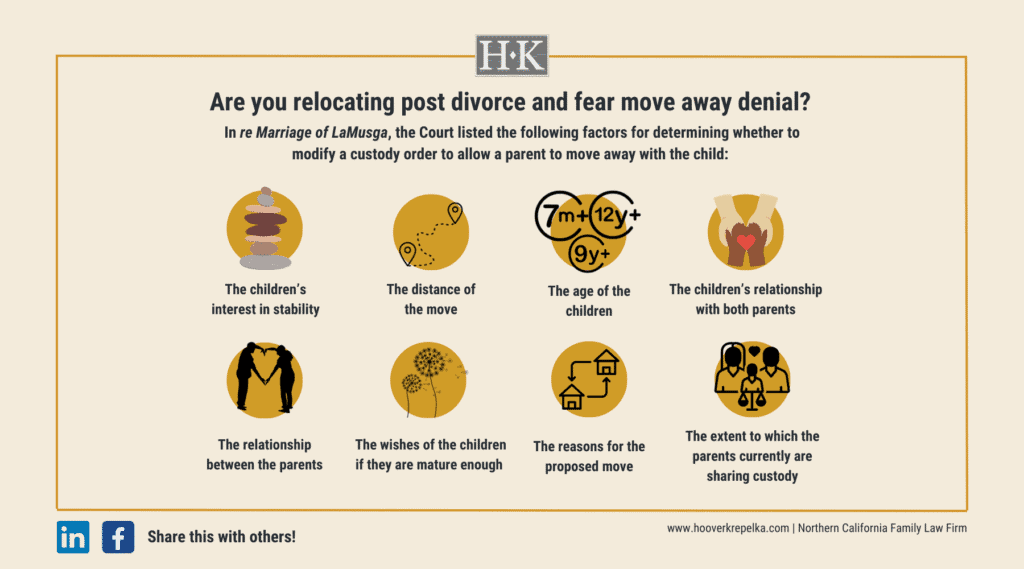
In California, a judge will look at a variety of issues that are collectively referred to as “Lamusga Factors” in determining whether one parent should be permitted to relocate with the child or children or if custody should be awarded to the parent who is staying in the current area. This term comes from a custody case, In re Marriage of Lamusga, in which the mother wished to move with her two sons over the objections of their father. In the ruling, the court noted that to decide on modification in custody in move-away cases, factors to be considered should include:
- the children’s interest in stability and continuity in the custodial arrangement
- the distance of the move
- the age of the children
- the children’s relationship with both parents
- the relationship between the parents, including, but not limited to, their ability to communicate and cooperate effectively, and their willingness to put the interests of the children above their individual interests
- the wishes of the children, if they are mature enough for such an inquiry to be appropriate
- the reasons for the proposed move
- the extent to which the parents currently share custody
In general, a parent who has an order granting them sole physical custody of their child is more likely to be able to move with their child. However, even then, if the noncustodial parent can show that the move would harm the child, the court can still say no to the custodial parent moving. Every case is different and will be examined on an individual basis by the judge. It is strongly advised that you discuss your situation with a family law attorney experienced in move-away cases to get a clearer idea of what to expect.
What Are Some Examples Of Why A Judge Will Deny Relocation?
Again, the court will be judging the suitability of a move through one important lens—what is in the best interests of the child. A judge may deny relocation because:
- The parents already have a strained relationship, and past behavior casts doubt on the moving parent’s willingness to support an ongoing relationship between the non-moving parent and the child.
- The move will result in the child having a diminished lifestyle or environment, for example, living in worse housing or going to an inferior school.
- The move is perceived to be out of spite or to minimize contact with the other parent.
It isn’t enough to show that there is some advantage, like a better job offer out of state, that is prompting the move. The relocating parent also has to show how it will still be possible for the child to maintain their connection with the other parent, especially if their parenting time will be modified from the current arrangements.
Experienced Family Law Representation in Silicon Valley
Child custody is a complex and emotionally charged issue, one that becomes only more so if one parent wants to relocate with the child. If you and your ex-spouse disagree over a possible relocation and you’re terrified you’re going to lose your relationship with your children, the compassionate family law attorneys at Hoover Krepelka are here for you. We’ll help you understand your rights and protect your children’s well-being and best interests. To schedule a consultation with an attorney, fill out the form below now.
Reach Out To Our Expert Attorneys Today
"*" indicates required fields
Frequently Asked Questions
Does a parent have the right to move out of state with their children after divorce?
Not automatically. While an adult can move freely, relocating with children typically requires either the other parent’s consent or court approval, especially when custody orders are in place.
What factors do judges consider when deciding on a child relocation case?
Judges assess what is in the child’s best interests, including the impact on the child’s relationship with both parents, the reasons for the move, and whether the move will provide significant benefits.
Can the parent left behind prevent the other parent from relocating with the children?
Yes. If the parents cannot agree, the court will decide whether to allow the relocation, balancing the child’s welfare with parental rights.